
How to get permits for classic car photo shoots in Italy
 Picture this: you’ve flown into Florence, booked a stunning 1960s Alfa Romeo Spider, scouted the perfect cobblestone street near the Ponte Vecchio, and assembled your entire creative team. Then, twenty minutes before the shoot begins, a municipal officer shuts everything down because you never filed for a public space occupation permit. The shoot is canceled, the car goes back to the garage, and you’re left scrambling to reschedule at significant cost. This scenario plays out more often than most organizers expect, and it’s entirely avoidable with the right preparation.
Table of Contents
- Understanding permit requirements for classic car photo shoots
- Preparing for the permit process: Documentation and lead times
- Navigating traffic control and public space logistics
- Camera crew accreditation and event-specific authorizations
- Historic vehicle rules and temporary travel documentation
- Hard-won lessons for organizing classic car shoots in Italy
- Enhance your classic car shoot with expert support
- Frequently asked questions
Key Takeaways
| Point | Details |
|---|---|
| Permit categories explained | You need different permits for simple photography, event shoots, or public-space occupation. |
| Lead times matter | Plan permit applications at least 7 days ahead to avoid scheduling and legal setbacks. |
| Traffic control is mandatory | Official traffic/crowd management bookings are essential for public space shoots in Italy. |
| Historic car compliance | Classic vehicles require separate documentation and temporary travel authorization for shoots. |
| Local support is key | Working with municipal offices and local fixers speeds up permit approval and avoids missteps. |
Understanding permit requirements for classic car photo shoots
Now that you know why permits matter, let’s break down Italy’s specific requirements.
Not every classic car photo shoot in Italy requires a formal permit. The deciding factor is almost always whether your activity affects public space. A quick lifestyle shot in a private courtyard or a rented villa driveway? Generally no permit needed. But the moment you step onto a public road, piazza, or park, the rules change completely.
Italy’s permitting landscape divides shoots into a few clear categories:
- Simple photography on public land with no equipment or vehicles blocking traffic: Usually requires only informal notification to local police (Polizia Municipale), not a formal permit.
- Shoots involving parked or moving classic cars on public roads: Require a public space occupation permit (Occupazione di Suolo Pubblico) from the local municipality.
- Shoots that close or restrict a road or lane: Require a road closure authorization plus mandatory traffic control services.
- Shoots at protected heritage sites (UNESCO zones, historic centers): Require additional clearance from the Soprintendenza (Italy’s cultural heritage authority).
As the Italy filming guide makes clear, a permit is needed if you are occupying or closing public roads or spaces. That single rule covers the vast majority of classic car shoots, since the whole point is usually to place a beautiful vehicle in a visually compelling public setting.
| Shoot scenario | Permit required | Issuing authority |
|---|---|---|
| Private property only | No | N/A |
| Public road, no closure | Yes (space occupation) | Municipal office |
| Road closure required | Yes (closure + traffic control) | Municipality + Police |
| Heritage or UNESCO site | Yes (multiple layers) | Municipality + Soprintendenza |
| Event-tied shoot (rally, festival) | Yes (accreditation + event permit) | Event organizer + Municipality |
“The key trigger is public space occupation. If your vehicle, crew, or equipment takes up any portion of a public road or square, you are legally required to obtain authorization before the shoot begins.” — Italy Fixers Filming Guide
Before you even think about booking your classic car rental or locking in a location, map out whether your planned spots fall under any of these categories. Doing this early saves enormous headaches later. You can also browse classic car tour options to get a feel for which routes and locations are most shoot-friendly.
Preparing for the permit process: Documentation and lead times
With the requirements clear, next comes preparing your paperwork and scheduling.
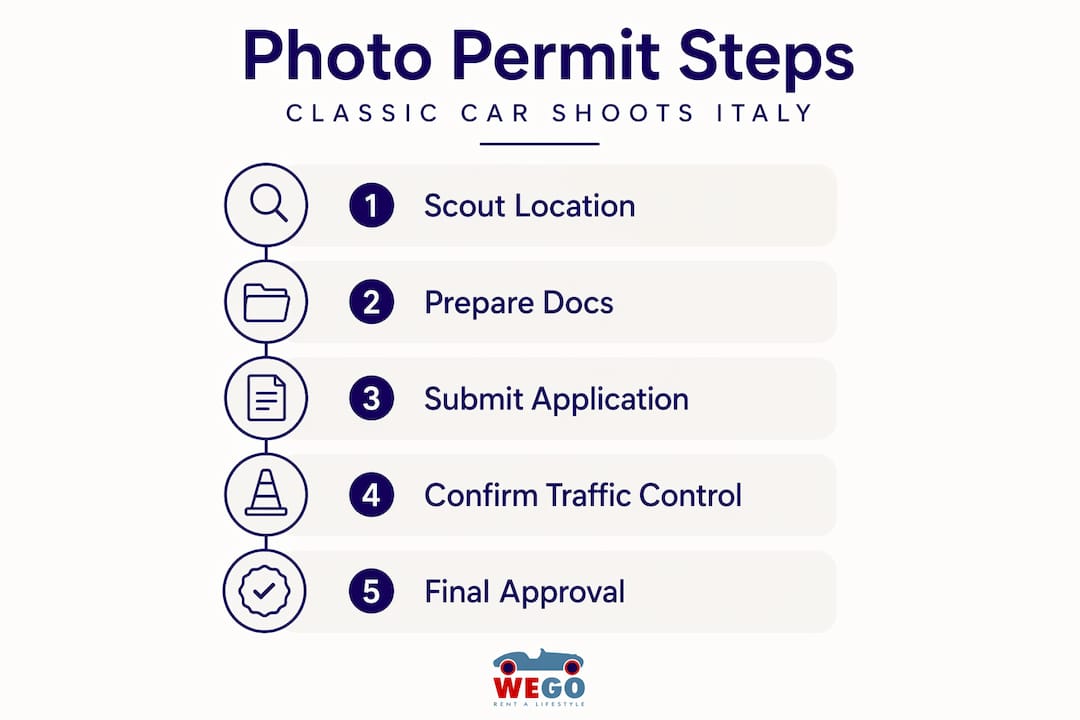
The Italian permit process is bureaucratic by nature, but it follows a logical sequence once you understand what’s needed. Here’s what you’ll typically need to gather before submitting any application:
- Completed application form from the relevant municipal office (Comune). Each city has its own form, so download the correct one for Florence, Milan, Verona, or whichever city you’re shooting in.
- Detailed shoot schedule including exact dates, times, locations, and a description of activities. Vague schedules get rejected or delayed.
- Liability insurance certificate covering the shoot, the vehicle, and any third-party damage. Most municipalities require a minimum coverage of €2 million.
- Vehicle documentation for every classic car involved, including registration and proof of roadworthiness.
- Traffic control booking confirmation from a licensed traffic management company. This must be arranged before the street permit is issued.
- Location map or diagram showing exactly where the car will be parked or driven, and where crew and equipment will be positioned.
The Italy film location scouting permits regional guide 2026 notes that traffic control booking must be confirmed before street permits are issued. This is a critical sequencing point that trips up many first-time organizers. You cannot get the permit without the traffic control booking, but you cannot book traffic control without knowing your exact schedule. Plan these two steps simultaneously.
On lead times: street permits require about 7 days of lead time under normal circumstances, but this extends significantly for heritage sites, major cities during peak summer season, or any shoot requiring road closures. In practice, experienced production teams in Italy aim for a minimum of three weeks of lead time, and four to six weeks for complex multi-location shoots.
| Document | Typical preparation time | Notes |
|---|---|---|
| Application form | 1 to 2 days | City-specific, download from Comune website |
| Liability insurance | 3 to 5 days | Must match shoot dates exactly |
| Traffic control booking | 5 to 10 days | Required before permit is issued |
| Vehicle documentation | 1 to 3 days | Includes historic plate verification |
| Full permit approval | 7 to 21+ days | Longer for heritage sites and summer |
Pro Tip: Submit your permit application at least four weeks before your shoot date if you’re working in peak tourist season (June through September). Municipal offices in cities like Florence and Rome operate at reduced capacity during August, and processing times can double without warning.
If you want classic car permit advice tailored to specific Italian regions, working with a provider who already knows the local permit landscape is a smart shortcut. You can also review historic car travel documentationrequirements to understand what vehicle paperwork you’ll need on the day.
Navigating traffic control and public space logistics
Once documentation is ready, handling traffic control and logistics becomes the next priority.
Traffic control in Italy is not optional when you’re occupying or closing public roads. It’s a legal requirement, and it’s also one of the most common scheduling bottlenecks for classic car shoots. According to Italy’s film location permitting regulations, traffic control is often mandatory and a scheduling bottleneck, especially in summer when tourist traffic is heaviest and licensed traffic management companies are booked months in advance.
What does traffic control actually involve for a classic car shoot?
- Licensed traffic officers (Vigili del Fuoco or private licensed operators) physically present at the shoot location
- Road signage and barriers placed according to municipal specifications
- Coordination with local police for road closure windows, often limited to specific hours (early morning is most commonly approved)
- A written traffic management plan submitted as part of the permit application
The practical implication is that your shoot window may be tightly constrained. Many municipalities only approve road closures between 6 a.m. and 8 a.m. before traffic peaks. If your creative vision requires golden-hour afternoon light on a busy Florentine street, you may need to negotiate hard or find an alternative location.
“In peak season, traffic management companies are booked weeks in advance. Securing your traffic control slot before finalizing your permit application is not just smart, it’s often the only way to guarantee your preferred shoot date.” — Italy Film Location Scouting Guide 2026
One highly effective solution is working with a specialist fixer or local production partner who already has established relationships with traffic management companies and municipal offices. The Italy Film Commissionoffers coordination support and can connect you with regional contacts who navigate these logistics daily.
For organizers who want to minimize friction, booking classic car shoot logistics through a provider who understands Italian road regulations can dramatically reduce the administrative burden. You can also explore historic car logistics tips for region-specific guidance on moving vintage vehicles to and from shoot locations.
Camera crew accreditation and event-specific authorizations
In event-based shoots, permit workflows shift towards accreditation.
If your classic car photo shoot is tied to a rally, concours d’elegance, or automotive festival, the permitting process looks quite different from a standalone street shoot. Events have their own authorization structures, and photographers working within them need to follow the event organizer’s accreditation process rather than (or in addition to) applying directly to the municipality.
Here’s the typical workflow for event-tied shoots:
- Identify the event’s official accreditation contact. Most major Italian automotive events have a dedicated press or media office.
- Submit a formal accreditation request including your publication or client credentials, the purpose of the shoot, and the specific dates you need access.
- Provide portfolio samples or a letter of assignment from your client confirming the commercial or editorial purpose.
- Wait for official confirmation before assuming access is granted. Accreditation is not automatic, and deadlines are firm.
- Receive your press badge or access credentials and review any restrictions on where you can position the car or crew.
As Fuori Concorso’s photography accreditation process demonstrates, photographer accreditation often includes explicit deadlines and official confirmation for event coverage. Missing an accreditation deadline by even one day can mean losing access entirely, with no recourse.
Pro Tip: Never publish or distribute photos taken at an accredited event before receiving official approval from the event organizer. Many accreditation agreements include embargo clauses, and violating them can result in legal action and permanent loss of future accreditation.
For wedding or private event shoots involving classic cars, the photographer permit process follows a slightly different path, typically requiring coordination between the venue, the local municipality, and any traffic management needs on the day.
Historic vehicle rules and temporary travel documentation
Aside from media permits, historic car documentation is an essential parallel step.
Italy has a specific legal framework for what qualifies as a historic or classic vehicle, and this framework directly affects how a car can be used during a photo shoot. Under Italian law, a vehicle qualifies as a historic car (autovettura d’epoca) if it is at least 30 years old, no longer in production, and maintained in original or authentically restored condition. These vehicles are registered under a special category and carry “targhe d’epoca” (historic plates).
The rules around these plates matter enormously for shoots. Italy has recently updated procedures for historic plates, including the assignment of original reproduction plates from 1931 onward. These changes affect how historic vehicles can legally circulate on public roads, including travel to and from shoot locations.
Key points every organizer needs to know:
- Historic vehicles with targhe d’epoca have restricted circulation rights in some urban areas and ZTL (Zona a Traffico Limitato) zones. Check whether your shoot location falls inside a ZTL before finalizing logistics.
- Temporary authorizations may be required for a historic car to enter restricted zones specifically for a shoot, even if the shoot itself is permitted.
- The vehicle’s insurance must explicitly cover commercial use if the shoot is for advertising or promotional purposes. Standard historic vehicle insurance often excludes commercial activity.
- Non-compliance carries real consequences: fines, vehicle impoundment, and immediate shoot cancellation are all possible outcomes.
Pro Tip: Always verify the historic plate status and ZTL restrictions for your specific vehicle and location at least two weeks before the shoot. Your rental provider should be able to supply this documentation, but confirm it in writing.
For shoots involving a historic car like the Fiat 124 Spider, understanding the vehicle’s specific plate category and circulation rights is part of responsible shoot planning.
Hard-won lessons for organizing classic car shoots in Italy
Having covered the process details, we want to share some practical lessons that don’t always make it into official guides.
The single most important factor in a successful Italian classic car shoot is not the car, the location, or the photographer. It’s whether you’ve fully mapped out your public space occupation needs before you do anything else. Every other element of the permit process flows from that one decision. Organizers who start by choosing a location and then figure out permits tend to hit walls. Organizers who start by asking “does this location require public space occupation?” and plan backward from the answer tend to succeed.
Early engagement with local authorities is not just good practice. It’s a competitive advantage. Municipal offices in cities like Florence and Siena deal with dozens of permit requests weekly. Applicants who come in early, with complete documentation and a professional approach, get faster approvals. Last-minute applicants get put at the back of the queue, regardless of how compelling their project is.
The hidden value of specialist fixers is something many organizers only discover after their first painful experience. A good Italian production fixer doesn’t just handle paperwork. They know which municipal officer to call, which traffic management company has availability, and which heritage sites are currently under stricter access rules. That knowledge is worth far more than their fee.
The three most common mistakes we see: submitting permit applications without traffic control confirmation, overlooking ZTL restrictions for historic vehicles, and assuming that a verbal agreement with a location owner is sufficient for public space shoots. None of these shortcuts work. Italy’s permitting system rewards preparation and punishes improvisation.
If you’re planning a classic car shoot experience in Italy, treat the permit process as part of the creative project, not an afterthought. The logistics are manageable when approached with the same care you’d give to lighting, styling, and composition.
Enhance your classic car shoot with expert support
When you’re ready to stage your shoot, quality rental and expert logistical support are invaluable.
At WeGo Now, we’ve built our services around exactly the kind of complex, detail-oriented shoots that require both a stunning vehicle and seamless coordination. Whether you’re planning a commercial campaign along the Tuscan hills or a luxury editorial in the streets of Verona, we understand what it takes to make it happen legally and beautifully.
Our classic car rental services include vehicles that are fully documented, insured for commercial use, and ready for the Italian roads you’ve been dreaming about. We also offer guidance on permit logistics, location selection, and coordination with local authorities, so your creative vision doesn’t get derailed by administrative hurdles. Explore our classic car day trips to find the perfect vehicle and route for your next project.
Frequently asked questions
How long does it take to get a street permit for a classic car shoot in Italy?
Street permits require about 7 days of lead time under standard conditions, but heritage sites and peak summer months can push that timeline to three weeks or more.
Are traffic control services mandatory for all public classic car shoots?
Yes, traffic control and crowd management are mandatory whenever you occupy or close a public road or space for a classic car shoot in Italy.
Do I need separate permits if my classic car photo shoot is tied to a rally or event?
Yes, event-tied shoots typically require photography accreditation or specialized event authorizations in addition to any standard filming permits.
What are the rules for temporary circulation of historic classic cars during photo shoots?
Italy requires updated documentation and sometimes temporary authorizations for historic vehicles circulating to and from shoot locations, especially in ZTL zones.
Who should I contact first to get support on the permit process for classic car shoots?
Start with the local municipality for space occupation permits, and consider using the Italy Film Commission’s coordination services for administrative guidance and regional location support.
